The First Seismic Movement
Before Transformation Appears, the Voice Begins to Speak


When I learned the earthquake had been felt in Jacksonville, my thoughts immediately returned to the city where my recovery journey began.
It reminded me that certain places become embedded within our personal landscapes. Years later, a headline, a conversation, or a memory can suddenly bring those chapters back into awareness.
The ground beneath us may shift physically, but our inner landscapes also carry fault lines, turning points, and moments that forever alter the terrain of our lives.
Before a song is sung, a voice must first risk speaking.
Before healing becomes visible, something often asks to be expressed.
Before trust is restored, there is frequently a moment when truth begins to move toward the surface.
One of the most striking features of the Psalms is their honesty.
They often begin in the midst of uncertainty.
The landscape has not yet settled.
Still, the voice begins to move.
Questions rise to the surface.
Pain is acknowledged.
Fear is expressed.
Grief is brought into the light.
Across cultures and throughout history, human beings have developed practices that create space for emotional expression within relationship and community.
Lament traditions, mourning rituals, chanting, prayer, drumming, storytelling, and communal song all reflect a recurring human pattern: expression often precedes integration.
The Psalms participate in this wider pattern while maintaining their own unique theological voice.
Many begin where transformation often begins in the throat.
The Threshold of Expression
The throat occupies a remarkable position within the body.
It sits at the intersection of breath, communication, emotion, and relationship.
When we feel safe, our voices tend to flow more naturally.
When we feel threatened, abandoned, ashamed, or afraid, our voices may change.
Words become difficult.
Breathing becomes shallow.
The chest tightens.
Expression narrows.
These responses are not failures.
They are adaptive responses designed to protect us.
Yet what remains unspoken can sometimes remain carried within us.
The Psalms offer something different.
They provide a structure through which distress can be expressed without severing relationship.
Again and again, the Psalmist speaks directly into connection.
“How Long?"
Psalm 13 opens with a question many people have asked in one form or another:
"How long, O Lord?”
The question repeats.
Anyone who has endured prolonged uncertainty may recognize this rhythm.
The same question arises again and again as the nervous system seeks orientation within an unsettled landscape.
The mind searches for meaning.
The heart seeks solid ground.
The question continues to surface.
The Psalm gives form to the question. Experience becomes articulated rather than carried in silence.
In doing so, the experience becomes shared rather than isolated.
When Pain Is Named
Psalm 22 deepens the movement.
"My God, my God, why have You forsaken me?"
The cry has echoed through centuries because it gives voice to one of the most vulnerable human experiences: feeling alone.
Yet something remarkable happens within the Psalm.
The conversation continues.
The relationship remains active even while the struggle is being expressed.
The speaker does not disappear into silence.
The voice stays engaged.
The dialogue remains open.
Throughout history, many wisdom traditions have recognized that articulation itself can be significant.
A spoken truth can begin organizing an experience that previously felt overwhelming or fragmented.
The Wound of Betrayal
Psalm 55 explores another form of suffering.
"If an enemy were insulting me, I could endure it ... but it is you."
Some wounds cut more deeply because they occur within relationships where trust once existed.
Betrayal carries a unique weight.
The pain often arises from the rupture of trust and the loss of what had once felt secure.
The Psalm gives language to that experience, allowing it to be witnessed rather than carried alone.
And through naming, the experience becomes something that can be witnessed rather than carried entirely alone.
Why Voice Matters
Across traditions, shared vocal practices have often served as a bridge between inner experience and communal connection.
Chanting shapes breath.
Drumming coordinates rhythm.
Call-and-response synchronizes voices.
Storytelling transforms private experience into collective meaning.
Different cultures express these practices differently, yet many reveal a common recognition:
Human beings often regulate through relationship.
The Psalms embody this principle through language directed toward connection.
The voice becomes a pathway.
A bridge between inner experience and relationship.
A bridge between suffering and meaning.
A bridge between isolation and participation.
The Beginning of Movement
One of the central insights of the Psalms is that transformation does not always begin with answers.
Sometimes it begins with articulation.
A question.
A cry.
A confession.
A truth finally spoken.
The movement may be small.
The landscape may appear unchanged.
Yet something has shifted.
The voice has moved.
And often, that is where the journey begins.
Modern culture often celebrates certainty.
We admire confidence.
We reward polished answers.
We are drawn toward conclusions.
The Psalms offer something different.
Many begin in uncertainty.
Questions remain unanswered.
Emotions remain active.
The landscape has not yet settled.
Yet the voice still moves.
This may be one reason the Psalms continue to resonate across centuries.
They do not require the speaker to arrive at immediate resolution.
They create space for truth to emerge while the process is still unfolding.
The voice becomes a bridge between experience and meaning.
A Human Pattern Across Cultures
The impulse to give voice to suffering appears throughout human history.
Ancient Mesopotamian lamentations mourned cities destroyed by war and disaster.
Greek tragedy transformed grief into communal reflection through spoken performance.
Traditional Irish keening used rhythmic vocal expression to accompany mourning and loss.
Many Indigenous traditions incorporated storytelling, song, and ceremonial speech to help communities process hardship and preserve collective memory.
In the Vedic tradition, sacred recitation carried teachings through generations, linking breath, sound, and meaning.
Across these traditions, vocal expression often served purposes beyond communication alone.
Speech became participation.
Sound became relationship.
Voice became a way of carrying experiences that were too large to remain entirely private.
Different cultures developed different forms.
A recurring pattern emerges: expression creates movement.
The Courage of Articulation
Many people assume strength means remaining silent.
The Psalms frequently suggest another possibility.
Strength may also appear in the willingness to speak honestly.
Psalm 13 asks:
“How long?”
Psalm 22 asks:
“Why?”
Psalm 55 names betrayal directly.
Each Psalm demonstrates a form of courage.
The courage to remain in relationship while expressing pain.
The courage to stay engaged while confronting uncertainty.
The courage to articulate what would otherwise remain hidden.
Throughout history, philosophers, mystics, and spiritual teachers have observed that language influences experience.
Words do more than describe reality.
They help organize it.
A journal entry can create clarity.
A conversation can reveal understanding.
A prayer can bring coherence to emotions that previously felt scattered.
A truth spoken aloud often carries a different weight than a truth held silently within.
The Space Between Heart and Mind
Many mystical traditions have described the throat as a threshold.
A meeting place where inner experience begins moving toward expression.
The heart feels.
The mind interprets.
The voice translates.
This symbolism appears in different forms across cultures.
In yogic traditions, the throat is associated with communication and authentic expression.
Jewish mystical writings often emphasize the creative and transformative power of speech.
Christian contemplative traditions have long explored the relationship between prayer, voice, and communion.
The forms differ.
The symbols differ.
Yet each recognizes the significance of expression.
Something changes when an experience finds language.
Something shifts when a burden is shared.
Something moves when silence gives way to voice.
Listening for the Emerging Voice
Much of life teaches us how to communicate with the world around us.
Less attention is often given to listening for what is still seeking expression within.
Which questions continue to surface?
What truth is asking to be acknowledged?
What grief seeks witness?
What gratitude remains unspoken?
The Psalms suggest that expression begins with presence rather than perfection.
Sometimes the first movement is simply honesty.
A question offered in sincerity.
A prayer spoken into uncertainty.
A whisper.
A conversation.
A single sentence that reflects what is genuinely present.
Meaningful change often begins long before it becomes visible.
It starts when awareness finds expression.
The voice begins to move.
The landscape gradually shifts.
New possibilities emerge.
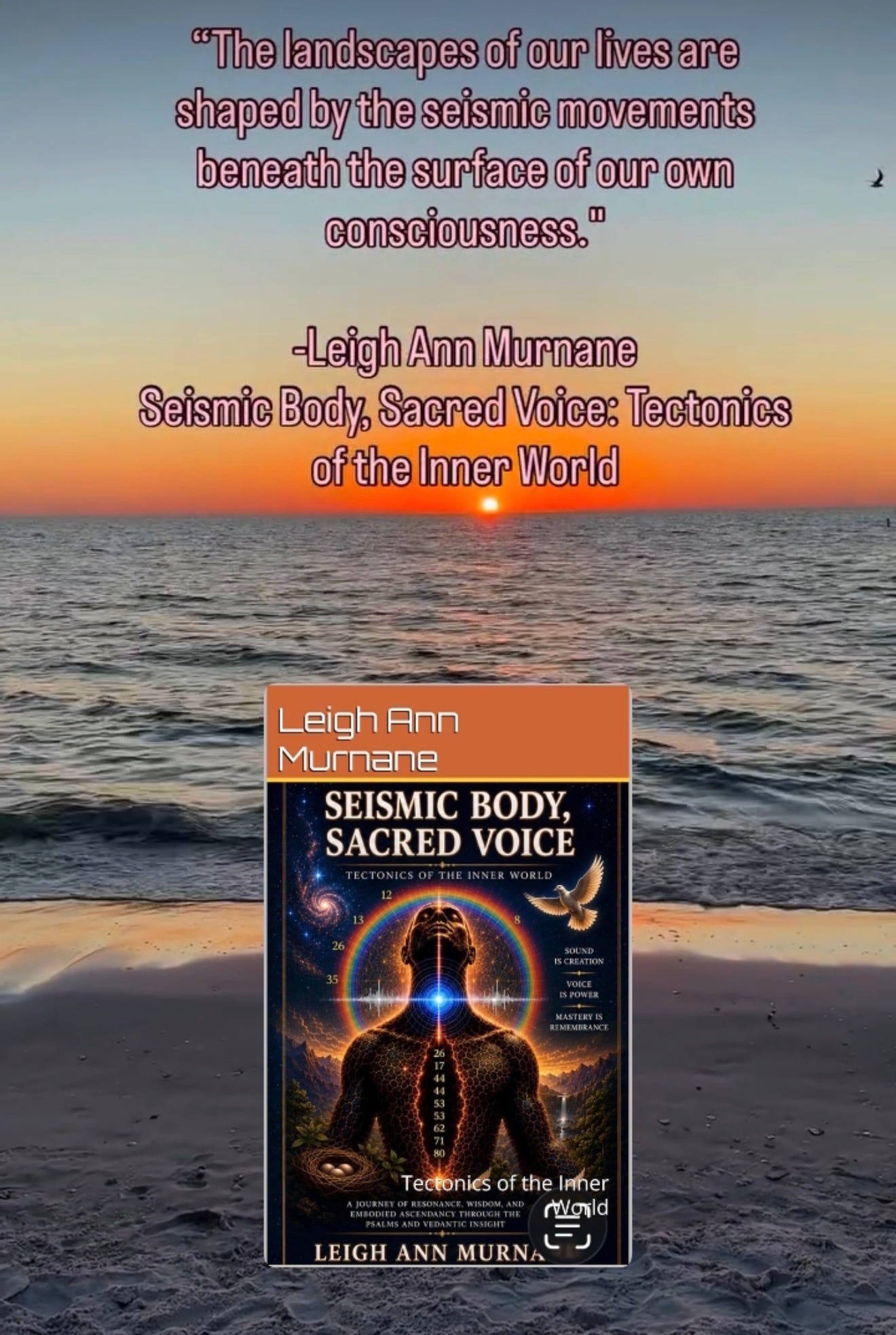
“The landscapes of our lives are shaped by the seismic movements beneath the surface of our own consciousness.”
- Leigh Ann Murnane, Seismic Body, Sacred Voice: Tectonics of the Inner World 📖
🌟Thank You for Being Here!🌈✨
🌻🌻🌻🌻🌻